Hudson Legal Technologies
Serious legal research,
within reach of every
practicing attorney.
We make one product. Hudson Corpus is the effective law of Iowa: the Code, the administrative and court rules, and every appellate decision, with an assistant that answers from the text and verifies every citation before you see it. Priced for a solo. Learnable in an afternoon. Built by a lawyer who believes the advantage AI gives a practice should belong to the whole profession, not only the firms that can afford it.
- Documents of effective Iowa law in the corpus
- 140,185
- Iowa appellate decisions, with 475,375 citations mapped between them
- 76,919
- A month for the Solo plan, the announced launch price
- $49
- Product. No suite, no add-ons. The corpus and the assistant over it.
- 1
Documents of effective Iowa law in the corpus
Iowa appellate decisions, with 475,375 citations mapped between them
A month for the Solo plan, the announced launch price
Product. No suite, no add-ons. The corpus and the assistant over it.
01 · Ethos · Who we are
A lawyer who builds software, and a standard we won't ship without.
Hudson Legal Technologies was started by a practicing attorney who writes software: the two things he cares most about, and a choice he refused to make. The company exists for one reason: to bring affordable, accessible, intuitive tools to the lawyers who actually practice.
That focus is deliberate. We do not make a suite. We make one research system, we build the corpus underneath it ourselves, and what we learn from that corpus we publish, with the method and the data attached, so a lawyer can check it.
Nick Hudson
Founder, Hudson Legal Technologies
The standard
- 01
Nothing is asserted that cannot be traced to the text.
Every answer traces to effective, citable law and is checked before it is delivered. Where the source does not exist, the system says so.
- 02
Serious tools belong within reach of the whole profession.
We build for solo practitioners, small firms and in-house teams, not only the institutions with procurement departments.
- 03
What we learn from the corpus, we publish.
The analysis that makes the product work goes out as data briefs and articles, frozen, sourced and open to being checked.
02 · Pathos · Why it matters
An attorney using AI will outperform one who isn't.
Anyone can now ask an AI a legal question and get a fluent answer in seconds. Your clients are doing it before they call you. Opposing counsel is doing it before they file.
The firms that have put AI to work are doing in an hour what used to take a day, and they will outperform the attorney who hasn't: on speed, on price, on the matters they can take on. That is the competitive reality of practicing law now, not a forecast.
The threat to the profession isn't AI. It's AI that only the largest firms can afford. If the advantage stays with the institutions with procurement departments, the solo and the small firm fall behind, and so do the clients who depend on them. Hudson exists so that isn't how it goes: research as capable as what the big firms are buying, priced for one lawyer, in the browser they already have open. And because this is law, built so every answer can be checked.
“The threat to the profession isn't AI. It's a profession where only the biggest firms have it.”
For every attorney to have it, it has to be
It has to be where the work already happens.
A browser tab, and the AI tools a practice already runs. Not another portal to remember to open.
It has to cost what a practice can pay.
A solo's research budget is real money. The price belongs on the website, not behind a sales call.
It has to be usable the day it arrives.
A five-lawyer firm has no training week to spare. If it needs one, it will not get used.
03 · Logos · The proof
One corpus of the effective law. Every answer checked against it.
Hudson Corpus is one research surface over the effective law of Iowa, retrieved, quoted and cited by an assistant that cannot answer from memory. The difference is what happens before you see the answer.
The corpus
- Caselaw
- 76,919
- Decisions of the Iowa Supreme Court and Court of Appeals
- Code
- 27,869
- Sections of the Iowa Code in force
- Administrative Code
- 17,690
- Rules of the Iowa Administrative Code, agency by agency
- Court Rules
- 1,193
- Rules: civil, criminal, appellate, evidence, professional conduct
Live counts · 475,375 citations mapped between the decisions as of 13 Aug 2026
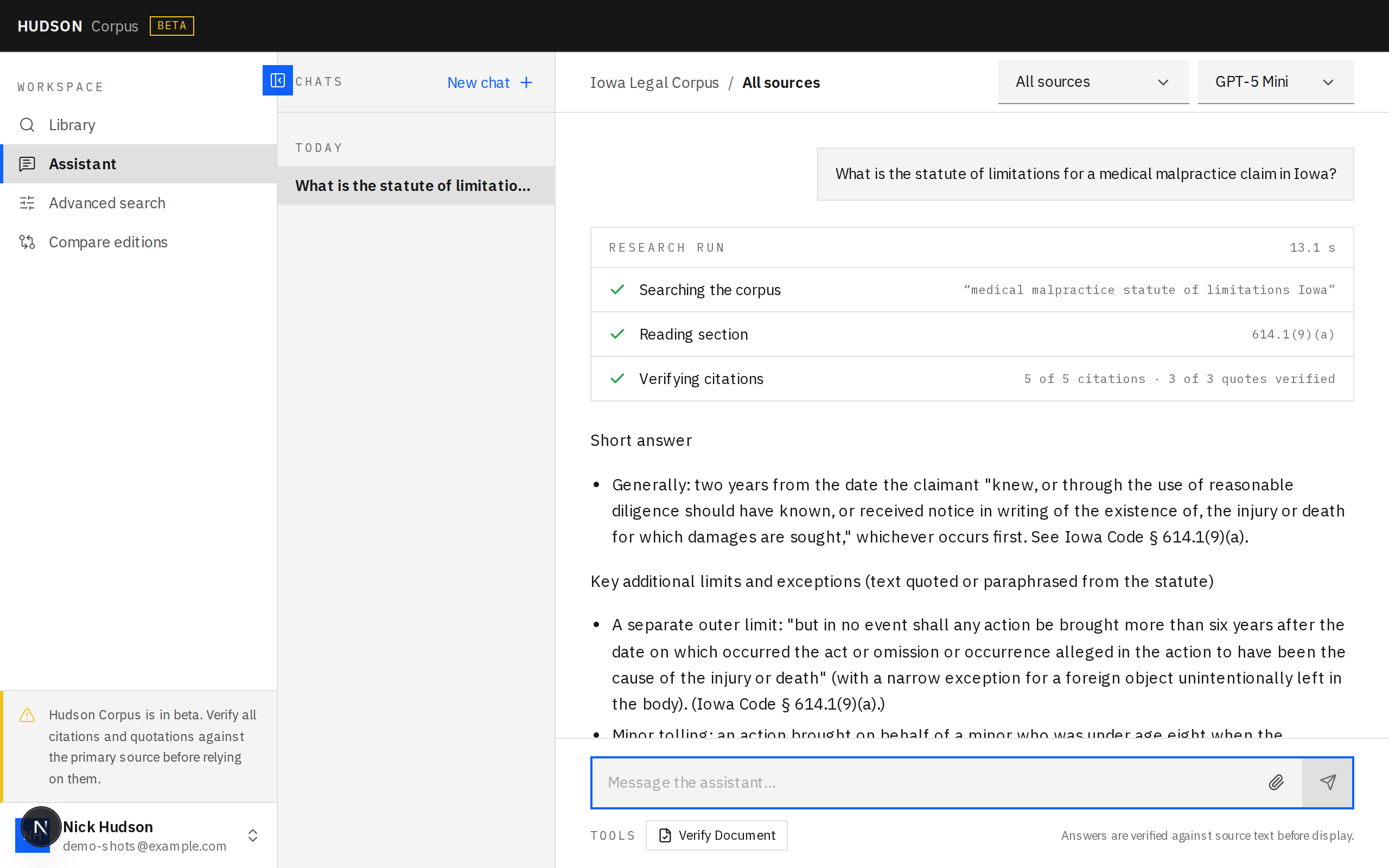
How an answer is made
- 01
Ask in plain language, or by citation number.
The assistant shows its work as it goes: what it searched and which sections it read.
- 02
It answers from the controlling text, and nothing else.
Retrieval runs against the human-reviewed corpus. No support in the record, no answer.
- 03
Every quote and citation is verified before you see it.
A deterministic pass checks each one against its source; anything superseded or overruled is flagged, not quietly served. The source is one click away.
Three tests, and the receipts
Accessible: where you already work.
In the browser, and over MCP for Claude and any MCP client: the same corpus and the same verification, inside the AI tools a practice already runs.
Web · MCP
Affordable: priced for a practice.
Solo at $49 a month or $490 a year. Firm at $149 a month with three seats. Public pricing, no per-search charges, and no sales call to find out what it costs.
Solo $49 / mo · Firm $149 / mo
Intuitive: learnable in an afternoon.
Ask, read the answer with every citation linked, open the source. That is the whole workflow. Nothing to configure and nothing to train.
Plain language in · Cited text out
04 · Pricing
Announced before launch, and the same for everyone.
Solo
or $490 / year, two months free
For the individual practitioner who lives in research.
Firm
includes 3 seats · $39 / month per added seat
For firms standardizing how the team does research.
Enterprise
Bar associations, county attorneys, legal aid & government.
These are announced launch prices. Billing hasn't started: beta access is open, and current users get clear notice well before anything is charged.
See what grounded research feels like.
In beta now. Ask a question, follow the citation to the source.